How Database Indexing Makes Applications Faster
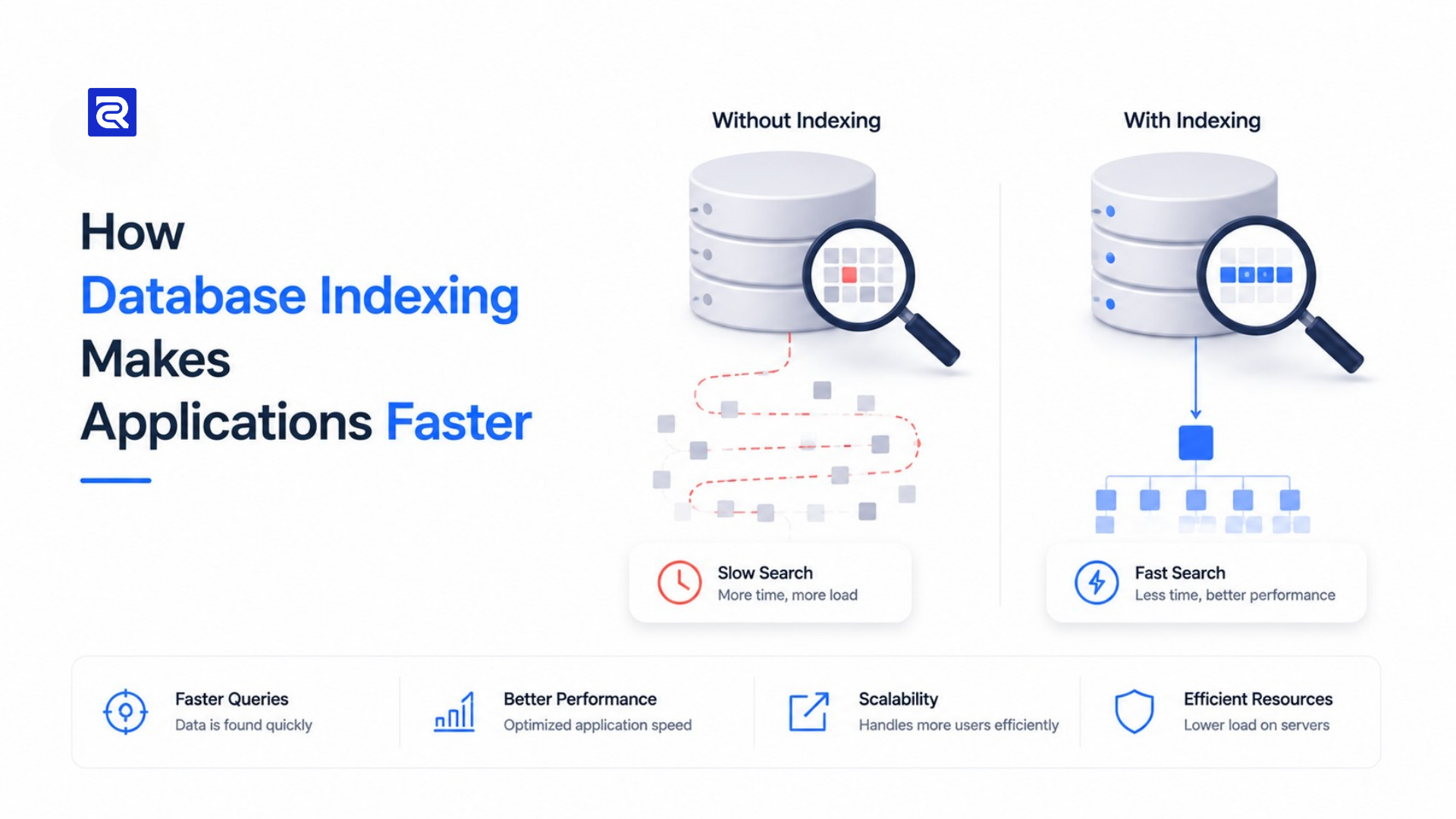
As web applications grow, their databases store more data. A query that feels fast with a few thousand records may become slower when the database contains millions of records.
That is where database indexing becomes important.
From a developer's perspective, database indexing is a practical way to improve query performance and help applications retrieve data more efficiently.
What Is Database Indexing?
A database index is a structure that helps the database find specific information without checking every record in a table.
Think about a large book. Instead of going through every page to find a particular topic, you can use the index to locate it quickly.
Databases use a similar concept.
For example, an e-commerce application may have thousands of customer records. When the application needs to find a customer using their email address, an appropriate index can help the database locate that record much faster.
How Does Database Indexing Improve Performance?
Without a suitable index, the database may need to check many records before finding the required information.
As the amount of data increases, this can affect application performance.
With a well-designed index, the database can locate relevant records faster. This can improve response times for frequently used searches and queries.
For developers, this becomes especially useful in applications where users regularly search, filter, sort, or retrieve large amounts of data.
Where Should Developers Use Indexes?
Developers should not add indexes to every column in a database.
Indexes are generally more useful for columns that are frequently used to search or filter data.
For example, an application may frequently search customers by email, retrieve orders using a customer ID, or filter products by a particular category.
Understanding how the application accesses data helps developers decide where indexing adds value.
The Importance of Query Patterns
Database indexing should be based on real application requirements.
A developer needs to understand which queries run frequently and which take longer than expected.
For example, if an application frequently searches a large customer table using one particular field, that field may be a good candidate for indexing.
This makes indexing more than a database configuration task. It becomes part of understanding how the application works.
Can Too Many Indexes Be a Problem?
Yes.
Indexes can improve data retrieval, but they also require storage and maintenance.
When new records are added, or existing records are updated, the database may need to update the related indexes as well.
Creating unnecessary indexes can therefore add additional work to the database.
A good developer focuses on useful indexes rather than simply creating more indexes.
Indexing and Growing Applications
Database indexing becomes increasingly important as an application grows.
Consider an online shopping application. It may store customers, products, orders, payments, and delivery information. As these records increase, frequently used database operations need to remain efficient.
Proper indexing can help applications handle growing datasets more effectively.
However, indexing is only one part of database optimization. Developers also need to consider query design, database structure, caching, application architecture, and server resources.
How Developers Identify Indexing Opportunities
Developers can monitor application performance and identify queries that take longer than expected.
Database tools can then be used to understand how those queries are being processed.
After making an indexing change, the query should be tested again to determine whether performance has actually improved.
This creates a simple development cycle:
Find the problem → Understand the query → Optimize the index → Test the result → Monitor performance.
This approach is more reliable than adding indexes without measuring their impact.
Conclusion
Database indexing makes applications faster by helping databases find information more efficiently.
For developers, the key is not to create as many indexes as possible. Instead, plan indexes carefully around real queries and application requirements.
When combined with good database design, optimized queries, caching, and a well-structured backend, database indexing can help create applications that remain responsive as data grows.